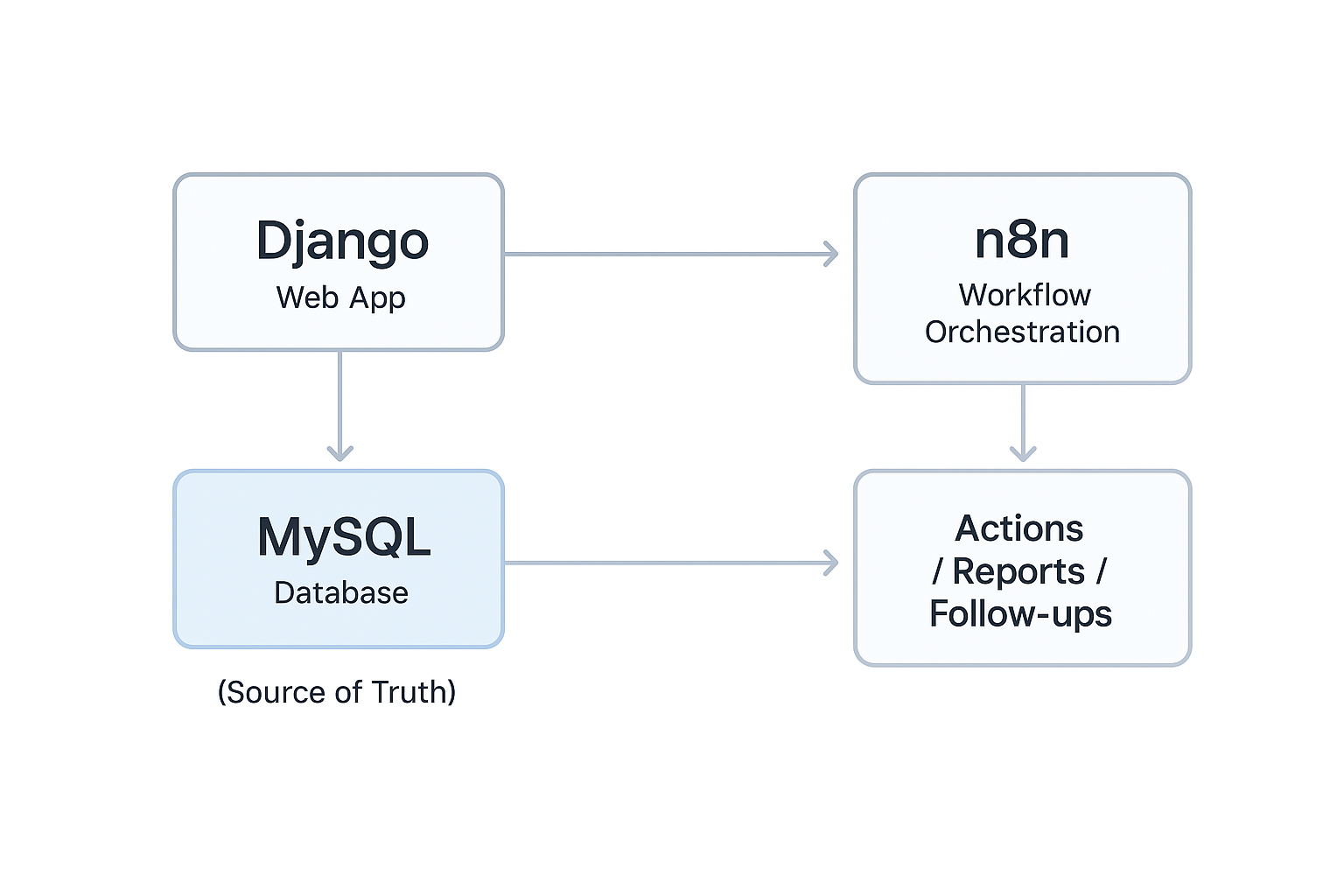
Modern AI applications are no longer just about prompts and models. The real value comes from how data is collected, orchestrated, enriched, and acted upon across systems. In this project, I built a production-ready workflow that combines Django, MySQL, n8n, and AI/LLMs into a clean, scalable architecture.
This post walks through the design approach and why each component was chosen.
The Problem: Turning Structured Input Into Actionable Intelligence
Many AI-driven products struggle with one of two problems:
- Forms are easy to build, but hard to automate reliably
- AI logic becomes tightly coupled to the web application
I wanted a system where:
- Data collection is reliable and transactional
- Automation is decoupled from the web app
- AI workflows can evolve independently
- Failures don’t break the user experience
Architecture Overview
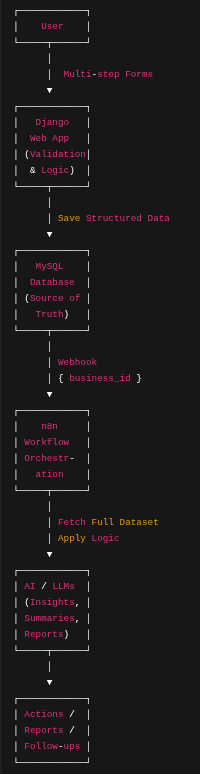
At a high level, the system works like this:
User → Django Forms → MySQL
                     ↓
               n8n Webhook
                     ↓
            Data Enrichment & AI
                     ↓
               Actions / Reports
Each component has a single responsibility.
Django: Reliable Data Collection
Django handles all user interaction and validation:
- Multi-step forms collect structured business data
- Data is saved transactionally into MySQL
- Each submission creates a
Businessrecord with related models
Why Django?
- Mature ORM
- Strong validation
- Excellent admin and management tooling
- Predictable request lifecycle
Importantly, Django does not run AI or automation logic. Its job ends once the data is saved.
MySQL: The Source of Truth
MySQL acts as the authoritative data store:
- All form data is normalized into relational tables
- Each business submission has a unique ID
- Related models (AI adoption, opportunities, consent) are linked via foreign keys
This allows:
- Reprocessing data at any time
- Auditing and debugging
- Safe retries without duplication
The database is the contract between systems.
n8n: Workflow Orchestration Layer
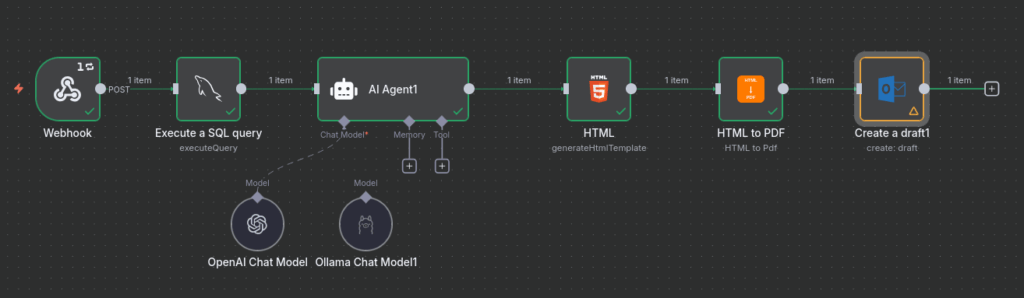
Once all forms are completed, Django triggers a lightweight webhook:
{
  "business_id": 123
}
That’s it.
From there, n8n takes over.
Why n8n?
- Visual workflows
- Built-in retry and error handling
- Easy integration with APIs, databases, and AI providers
- Non-developers can modify logic safely
n8n then:
- Pulls full data from Django via an internal API
- Aggregates related records
- Applies logic, transformations, and branching
- Triggers AI enrichment where needed
AI & LLMs: Decoupled and Optional
AI is intentionally placed outside the Django app.
This provides several benefits:
- Models can be swapped (OpenAI, local LLMs, cloud providers)
- Rate limits don’t affect the web app
- AI failures don’t break form submissions
- Prompts and logic evolve independently
In practice, AI is used to:
- Generate structured insights
- Summarize business contexts
- Create recommendations
- Draft human-readable reports
But the system works even if AI is temporarily disabled.
Why This Architecture Works
This separation delivers real advantages:
- Resilience: Users never wait for AI or automation
- Scalability: Web traffic and AI workloads scale independently
- Maintainability: Each layer has a clear responsibility
- Security: No direct database access from n8n to the web layer
- Flexibility: Workflows can change without redeploying Django
It’s a pattern that works just as well for:
- AI assessments
- Lead qualification
- Internal tooling
- Data enrichment pipelines
Final Thoughts
This project demonstrates that modern AI systems are less about “calling a model” and more about orchestration.
Django provides stability.
MySQL provides truth.
n8n provides automation.
AI provides intelligence.
When each does its job well, the result is a system that is powerful, adaptable, and production-ready.
No responses yet