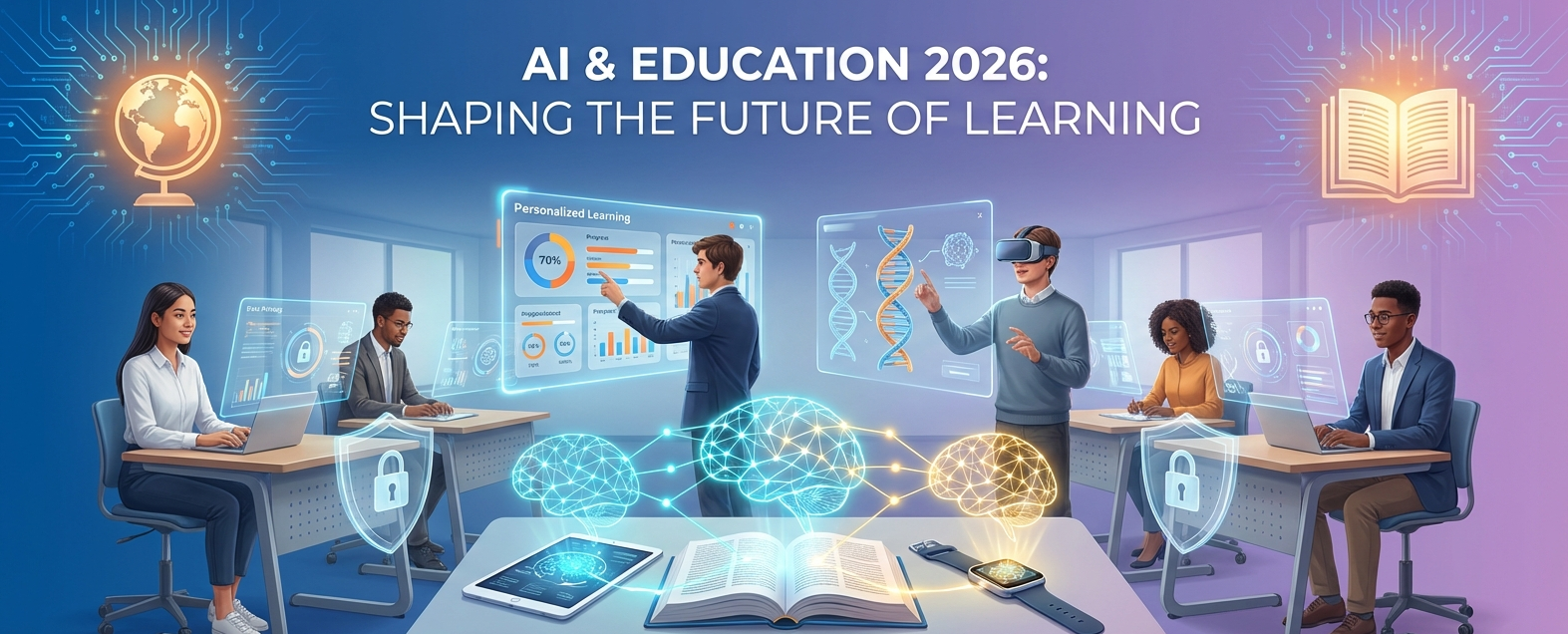
AI and Education 2026: Transforming Learning Landscapes with Intelligent Innovation
Estimated reading time: 8 minutes
- AI becomes essential infrastructure in education
- Personalised learning systems evolve with AI
- Data privacy and integrity remain critical concerns
- Implementation of immersive technologies in classrooms
- SMEs play vital roles in shaping AI in education
Table of Contents
- From Novelty to Essential Infrastructure: The Core Transformation of AI in Education
- Unlocking Personalised and Adaptive Learning at Scale
- Tackling Critical Educational Challenges with AI Solutions
- Immersive Technologies and Hybrid Learning: Integration of VR, XR, and More
- Building Holistic Educational Ecosystems with AI
- Practical Implementation: Supporting Teachers and Safeguarding Integrity
- Enterprise-Level AI Adoption in Higher Education Institutions
- Data Privacy and the Quest for Balance
- Practical Takeaways for SME Professionals and AI Agencies in Education
- How Our Expertise Can Help You Navigate AI and Education in 2026
- Conclusion and Call to Action
From Novelty to Essential Infrastructure: The Core Transformation of AI in Education
By 2026, AI ceases to be merely a novelty or pilot project in educational settings. Instead, it emerges as a mainstream classroom infrastructure across schools, colleges, and universities globally — a transition robustly predicted by eSchool News (source). Education districts have shifted focus from merely exploring cutting-edge capabilities to prioritising AI solutions that measurably improve student outcomes.
This maturation is facilitated by several key enablers:
- Clearer guardrails and safety standards: Institutional policies are increasingly formalised, providing frameworks to implement AI responsibly and ethically (source).
- Wider acceptance among educators and administrators: Nearly all superintendents express excitement about AI’s potential but remain cautious about challenges like academic integrity and access equity (source).
This foundational shift signals a new era where AI tools are integrated thoughtfully and sustainably, setting the stage for deeper innovation.
Unlocking Personalised and Adaptive Learning at Scale
One of the most significant advancements anticipated by 2026 is the rise of truly adaptive learning systems that adjust in real time to each learner’s needs (eSchool News). Unlike early personalised learning tools, these AI systems dynamically interpret realtime engagement data — including voice cues, interactive responses, and optional camera-enabled feedback — to modulate difficulty level, learning modality, and instructional pacing.
This evolution creates a learning environment akin to receiving a personal tutor experience at scale, transforming education into a responsive conversation rather than a static curriculum. Some exciting characteristics of these intelligent tutoring systems include:
- 24/7 student support outside classrooms: AI-powered tutoring can provide instant explanations and targeted practice exercises, enabling students to study effectively beyond school hours.
- Teacher augmentation, not replacement: Rather than supplanting educators, AI tools relieve teachers of routine grading and feedback burdens, empowering them to focus on higher-value instruction and relationship building with students.
- Increased engagement and comprehension: This tailored approach accelerates understanding by meeting students where they are, often alleviating chronic disengagement.
For AI agencies and workflow automation specialists, integrating these AI-driven adaptive systems with platforms such as Learning Management Systems (LMS) via automation tools like n8n workflows is a massive opportunity. Automations can streamline data flow between AI tutors, student information systems, and teacher dashboards, ensuring timely insights and personalised content delivery.
Tackling Critical Educational Challenges with AI Solutions
Education systems continue to struggle with entrenched problems such as chronic absenteeism, student disengagement, and disparate readiness levels. AI is uniquely positioned to provide scalable, data-driven interventions designed to address these issues efficiently.
Notably, AI plays an important role in:
- Student wellbeing and mental health monitoring: Through sentiment analysis and behavioural tracking, AI tools detect early warning signs and connect students to appropriate support services, complementing academic instruction (source).
- Precision in test preparation: AI platforms analyse students’ strengths and weaknesses at granular levels, crafting study plans tailored to individual learning styles rather than one-size-fits-all approaches.
- Enhancing equity: AI can help personalise learning experiences for diverse student populations, potentially narrowing achievement gaps by offering support where it is most needed.
For SMEs specialising in AI-driven education technology, there’s a strategic imperative to develop solutions that responsibly address these critical challenges—leveraging workflow automation to scale outreach, track metrics, and deliver timely interventions.
Immersive Technologies and Hybrid Learning: Integration of VR, XR, and More
Immersive technologies such as Virtual Reality (VR), Extended Reality (XR), and hybrid learning models are fast becoming mainstream by 2026 (source). These technologies supplement traditional in-person instruction with interactive, hands-on virtual experiences, significantly benefiting:
- High schools and career technical education (CTE) centres: They use VR/AR to simulate real-world work environments and job scenarios, preparing students better for workforce demands.
- Skill acquisition and knowledge retention: Immersive experiences promote deeper understanding, engagement, and faster mastery of content.
- Development of transferable skills: Features like multiplayer collaboration within VR environments nurture communication, teamwork, and problem-solving competencies.
For AI agencies, integrating immersive tech solutions with workflow automation platforms opens possibilities for creating seamless learning experiences. Automation workflows can manage session scheduling, performance tracking, resource allocation, and feedback loops—optimising operational efficiency and user satisfaction.
Building Holistic Educational Ecosystems with AI
By 2026, educational technology transcends isolated academic support to form comprehensive ecosystems that encompass:
- Monitoring mental health and emotional well-being
- Developing work-applicable soft skills and critical thinking
- Offering college and career guidance with AI-driven insights
- Facilitating peer communities and collaborative learning
- Tracking student progress longitudinally across academic careers
Additionally, gamification—rooted in learning science principles—is widely used to engage students deeply with complex concepts, making learning more enjoyable and effective.
Such systems require sophisticated integration across multiple platforms and data sources. SMEs and AI agencies can leverage n8n workflows to automate data connectivity, reporting, and custom alerts, helping educational institutions maintain cohesive and responsive digital ecosystems.
Practical Implementation: Supporting Teachers and Safeguarding Integrity
Despite the enthusiastic adoption of AI, real-world implementation faces hurdles:
- Concerns about academic integrity: A considerable number of students admit to using AI tools without permissions; meanwhile, teachers often face challenges detecting misuse (source).
- Equitable access: Ensuring all students benefit from AI tools remains an ongoing challenge amid digital divides.
- Teacher preparedness and AI literacy: More professional development is vital. Many school districts offer teacher training in AI literacy to help educators critically employ and monitor AI resources effectively (source).
- Policy development: With at least 32 states releasing AI guidelines for schools, proactive policy design is becoming standard practice, safeguarding responsible AI use in education.
For AI agencies, consulting on policy frameworks, developing AI literacy programs for educators, and delivering transparent, user-friendly AI solutions represent critical service opportunities. Workflow automations can also assist by managing compliance reporting and automating pedagogical feedback loops, lightening educators’ administrative loads.
Enterprise-Level AI Adoption in Higher Education Institutions
Higher education is adopting an enterprise-wide approach to AI management, moving beyond siloed experimentation to comprehensive policy frameworks and infrastructure investments (Tyton Partners). Research indicates over 40% of institutions will have enterprise-wide AI deployment within the coming three years.
Institutions that adopt a collaborative stance—integrating AI in partnership with faculty, students, and staff—tend to realise better outcomes than those taking a defensive or restrictive posture.
This trend signals increasing demand for expert AI consultation, integration services, and robust, scalable workflows that connect AI applications across departments and functions. Automated workflows play a critical role in orchestrating data handling, user access, and cross-platform synchronisation essential for large-scale AI adoption.
Data Privacy and the Quest for Balance
With escalated AI usage comes heightened concerns over student data privacy and safety. Drawing lessons from the social media industry’s challenges with youth wellbeing, schools are becoming vigilant about implementing protective measures tailored for AI’s specific data demands (source).
The key consideration moving forward is balance: Innovation must be intentional, aligning technology with instructional goals, managing teacher workload, accounting for tighter budgets, and preventing technology from distracting learners (source).
AI and workflow experts must prioritise privacy-compliant design, transparent data practices, and engaging stakeholders in policymaking and deployment decisions to earn trust and maximise impact.
Practical Takeaways for SME Professionals and AI Agencies in Education
- Focus on measurable outcomes: Develop AI solutions that clearly demonstrate improvements in student engagement, retention, and performance instead of trailing novelty features.
- Champion teacher empowerment: Build products that augment, not replace, educators; provide AI literacy training and simple, interpretable tools.
- Leverage workflow automation: Use platforms like n8n to integrate diverse systems — from AI tutors to LMS and administrative tools — creating seamless and scalable education ecosystems.
- Advocate for data privacy and ethics: Ensure compliance with emerging guidelines; implement transparent data use policies and embed privacy protections in workflows.
- Align with institutional policies: Stay ahead by anticipating and shaping AI governance, positioning your services as trusted partners in the education sector’s AI transformation.
How Our Expertise Can Help You Navigate AI and Education in 2026
As a leading AI agency and workflow automation specialist based in the United Kingdom, we are uniquely positioned to support education providers and technology developers in harnessing the power of AI responsibly and effectively.
Our services include:
- Designing and deploying adaptive AI learning systems tailored to institutional needs.
- Developing n8n workflows that automate data exchange between AI applications, learning platforms, and administrative systems—reducing manual workloads and accelerating insights.
- Consulting on AI literacy training and policy frameworks ensuring smooth and compliant technology adoption.
- Integrating immersive technologies such as VR and XR with AI-powered workflows to enrich learning experiences.
- Implementing privacy-first AI solutions balancing innovation with student data protection.
By partnering with us, educational institutions and edtech SMEs can focus on their mission—delivering high-quality education — while we empower them with cutting-edge AI solutions and automation expertise.
Conclusion and Call to Action
The future of AI and education in 2026 is bright, brimming with opportunity to transform learning and teaching profoundly. Yet, success hinges on balancing innovation with responsibility, integrating AI thoughtfully, and supporting educators effectively. SME professionals and AI agencies have vital roles to play in this journey by creating scalable, student-centered tools and intelligent workflows that meet evolving demands.
Are you ready to harness AI’s transformative power to elevate educational outcomes? Contact us today to learn how our AI expertise and workflow automation solutions can help your organisation innovate confidently and effectively in the education sector. Together, let’s build the future of learning.
References and further reading:
- eSchool News – 2026 Innovations in Education
- Tyton Partners – Higher Education Trends in 2026
- Discovery Education – 2026 Education Trends
- K12 Dive – 6 K-12 Trends to Watch in 2026
Comments are closed